TestMax, comparisons and ROI
What Is TestMax? The Requirement Driven AI Testing Platform
TestMax is a requirement driven AI testing platform by Mammoth-AI. Here is what TestMax does, how it works, its key features and who it is for.
Quick answer
TestMax is a requirement driven AI testing platform built by Mammoth-AI. It imports requirements from Jira, Azure DevOps or documents, scores them for quality and testability, scans the real application, generates test cases and editable Playwright scripts, runs them and links every result back to the original requirement. TestMax covers web UI and API functional testing.
4 min read
TestMax is a requirement driven AI testing platform built by Mammoth-AI. It turns requirements into executed test evidence for web UI and API functional testing. Most testing tools start with scripts. TestMax starts with what the software is supposed to do, checks that requirement for gaps, reads the real application and then builds, runs and reports the tests.
Not to be confused with other products that share the name, TestMax by Mammoth-AI is a software testing platform for QA and engineering teams.
TestMax
Why TestMax starts with the requirement
A test suite can only be as good as the requirement it came from. When a user story is vague, the tests built from it are vague too. AI tools will happily generate tests from a weak requirement without ever questioning it.
TestMax scores every requirement for quality and testability before a single test is created, then suggests improvements for your team to review. This brings static testing and shift left analysis into the daily workflow, so weak requirements are fixed early instead of turning into weak tests. We call this approach requirement driven testing.
How TestMax works: from requirement to evidence
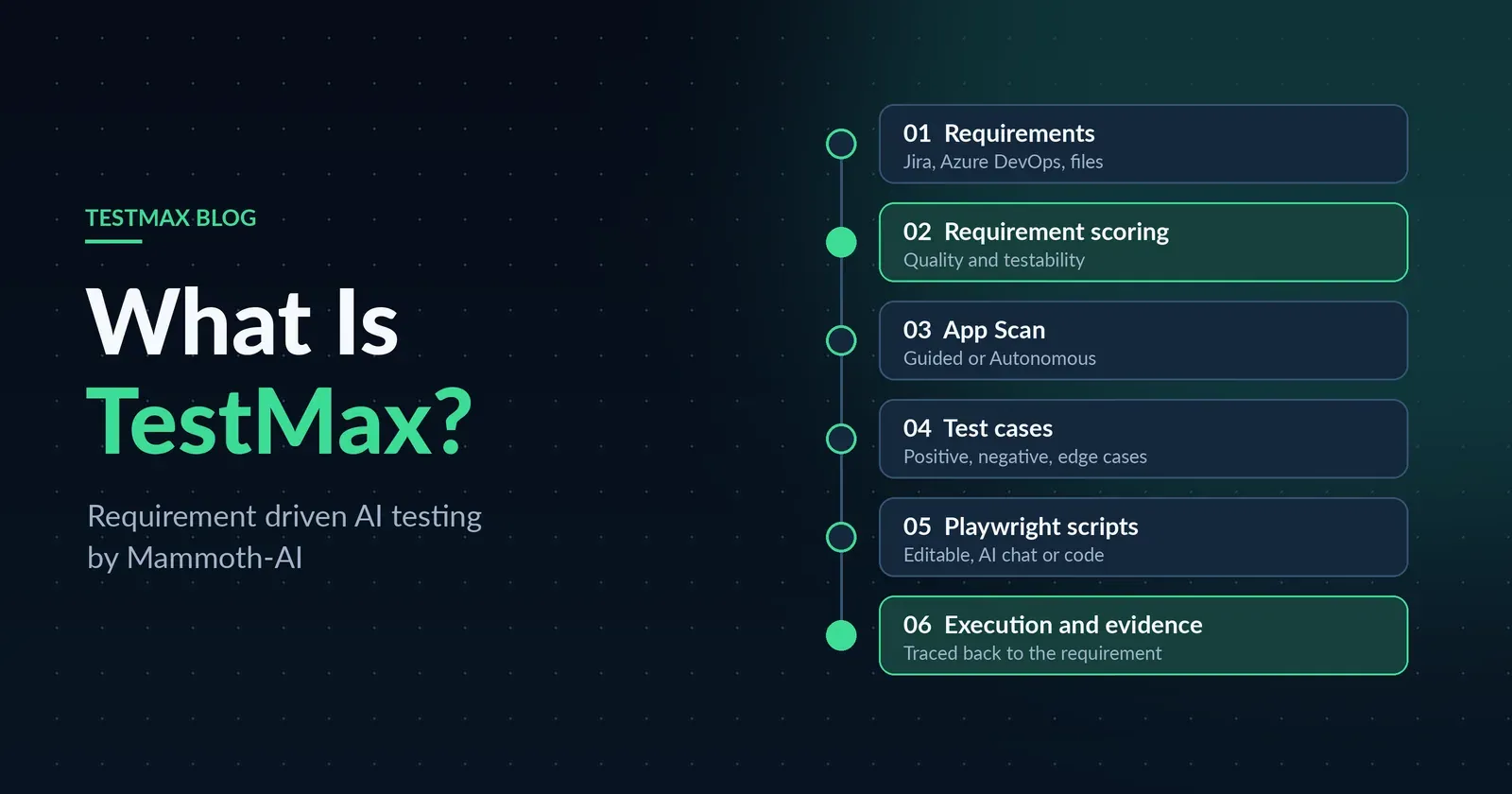
TestMax connects every testing step in one workflow.
- Requirements. Import work items from Jira or Azure DevOps, upload Word, PDF or CSV files, or write requirements directly in TestMax. Review, edit, confirm or discard what was extracted, find near duplicates and classify requirement types.
- Requirement scoring. TestMax checks each requirement for clarity, completeness, consistency, atomicity and testability, each scored out of 5. It highlights gaps and suggests AI improvements for your review.
- App Scan. In Guided mode, a tester walks through the workflow while AI captures the screens and actions. In Autonomous mode, AI explores the application based on the requirement. Both modes capture real fields, labels, buttons, navigation and element locators.
- Test cases. TestMax generates positive, negative, validation, boundary and edge case scenarios. Each test case keeps its objective, preconditions, test data, steps and expected results linked to the source requirement.
- Test scripts. TestMax creates editable Playwright scripts in TypeScript, JavaScript, Python, Java or C#. You can refine a script by asking for changes in plain language or by editing the code directly.
- Execution and evidence. Run scripts one by one or in batches and follow live logs. Reports show step level results, duration, error details, screenshots and AI supported analysis, and you can download them as PDF or CSV.
Here is a simple example. A requirement may say "username", but the real login form asks for "Email Address". App Scan supplies the actual field, so the tests TestMax generates match the real application.
Key features of TestMax
Requirement intelligence. Add BRDs, diagrams, schemas and user flows as AI context, and link requirements through prerequisites and postconditions.
Test data management. Define named data variations for the same scenario, upload test data files and run data driven tests without creating a separate test case for every dataset.
Automation resilience. TestMax uses several locator strategies, including semantic identifiers, test IDs, CSS and XPath. When an element changes, self healing tries alternative locators, and a targeted rescan helps AI find a replacement. Self healing can be switched on or off at execution time.
Traceability and evidence. Requirements, test cases, scripts, executions and evidence stay connected, so your team can follow any result back to the requirement behind it.
Enterprise controls. Organisation, workspace and project controls, predefined and custom roles, action level permissions, user invitations and AI credit logs with alerts.
Explore the full AI test automation platform and see how AI test execution works in TestMax.
TestMax integrations
Jira: TestMax imports filtered work items from Jira as requirements.
Azure DevOps: TestMax fetches requirements and existing test cases, exports test cases, scripts and logs, tracks requirement sync status and pushes selected scripts to a configured Azure DevOps repository.
Learn more about the Jira test automation integration.
How TestMax is different
This connected flow is a practical step toward hyperautomation in software testing.
Teams often ask how TestMax compares with Katalon, Mabl or testRigor. Those are established test automation tools, each with its own way of creating tests. TestMax starts from the written requirement: it scores and improves the requirement, generates test cases and editable Playwright scripts, runs them and links every result back to the requirement, with your team approving each step. For a side-by-side look at one of them, see TestMax vs Katalon.
Who uses TestMax?
TestMax is built for QA leads, QA managers and engineering leaders at mid size and enterprise companies that already use Jira or Azure DevOps. It fits teams in banking and fintech, insurance, healthcare, retail and SaaS, where releases must be fast and every change must be tested and proven.
Teams usually choose TestMax when test writing cannot keep up with development, when scripts break with every release or when audits need clear evidence of what was tested. These problems are covered in our guide to automation testing challenges.
Security and getting started with TestMax
TestMax offers hosted and on premises deployment, with role based access across your organisation. Read more on the secure test automation platform page, or learn more about TestMax and Mammoth-AI.
See your own requirement become executed test evidence. Book a TestMax demo.