AI test automation
Automation Testing Challenges: 9 Problems and How to Fix Them
Most QA teams already automate, yet many still feel stuck. Here are the 9 biggest automation testing challenges and how to fix each one at the source.
Quick answer
The biggest automation testing challenges are tests that break when the app changes, flaky results, unclear requirements, coverage gaps, slow test writing, test data problems, disconnected tools, skill gaps and unclear ROI. Most of them start before a single test is written. Clear requirements and a connected test flow fix the root cause.
5 min read
Most QA teams already have test automation. Yet many still feel stuck. Releases wait on QA, tests break after every sprint and leaders ask why automation has not paid off.
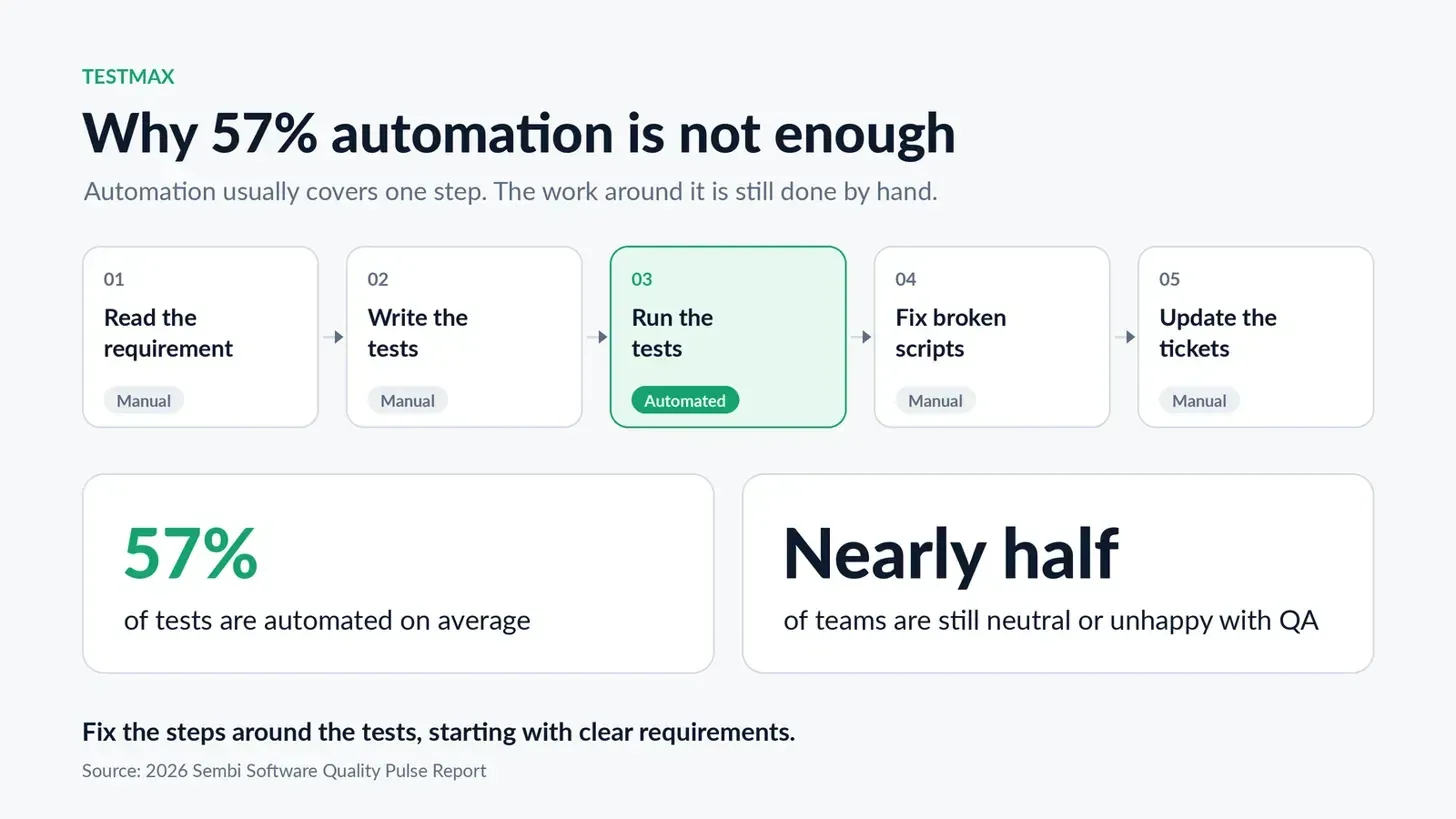
Recent data shows how common this is. Teams now automate 57% of their tests on average, yet nearly half are neutral or unhappy with their QA process, according to the 2026 Sembi Software Quality Pulse Report (Ranorex). More automation alone does not solve the problem.
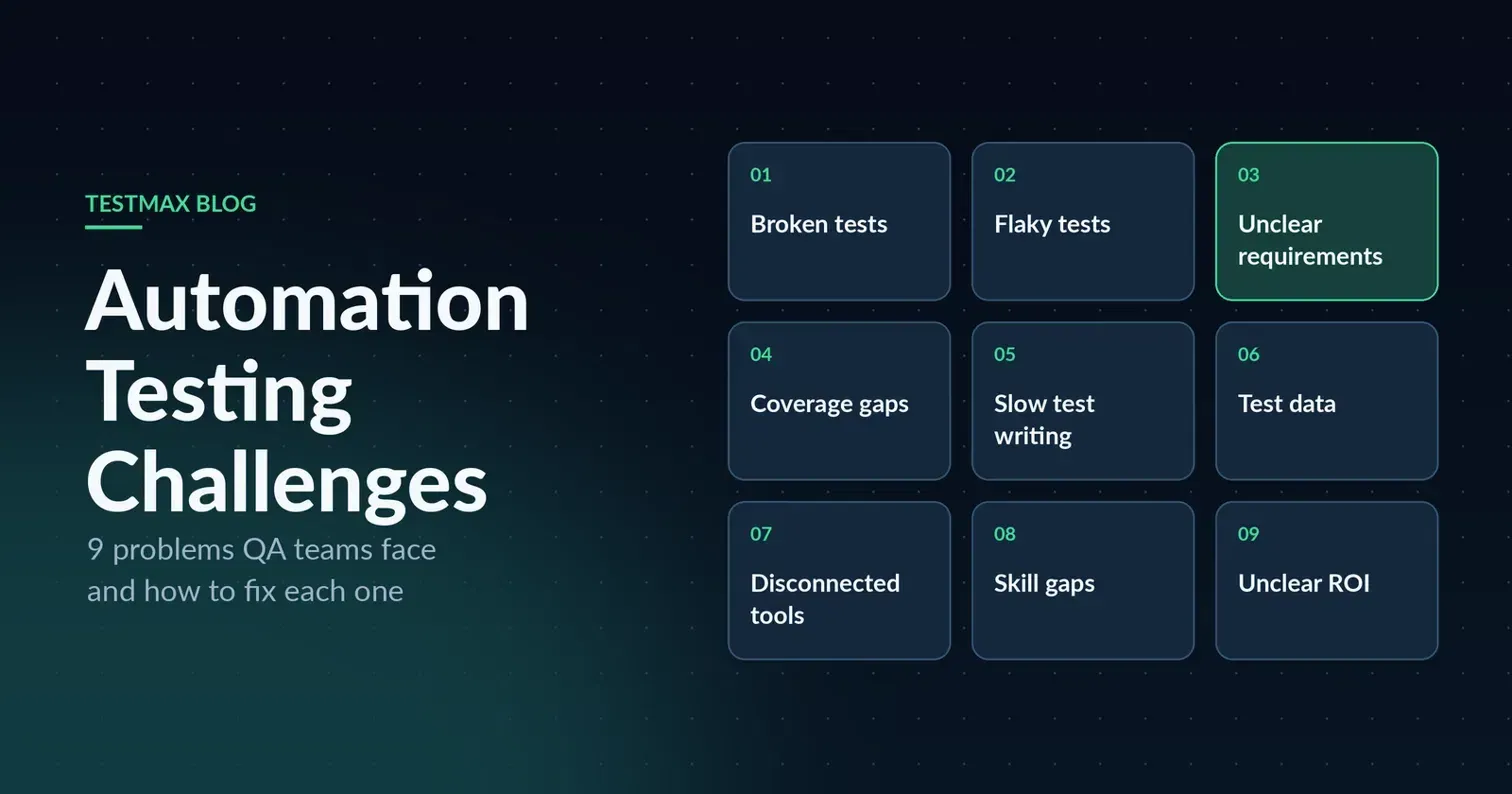
Below are the nine automation testing challenges we see most often, with a practical fix for each one.
What are the biggest automation testing challenges?
The biggest challenges are test maintenance, flaky tests, unclear requirements, coverage gaps, slow test creation, test data, disconnected tools, skill gaps and proving ROI. Most of them share one root cause. Tests are built from scripts and assumptions instead of clear requirements.
9 automation testing challenges and how to fix them
Tests break every time the app changes
A button moves or a field gets renamed and dozens of scripts fail. The team spends the sprint repairing tests instead of finding bugs.
Fix: Use stable locators and keep each test tied to what the feature should do, not how the page looks. AI tools that update tests when the app changes can remove most of this repair work.
Flaky tests nobody trusts
A test passes, then fails, then passes again with no code change. Soon the team ignores failures and real bugs slip through.
Fix: Track flaky tests separately, find the cause and fix or remove them quickly. The usual causes are timing, test data and shared state. Our guide on flaky tests explains each one in detail.
Requirements are unclear or keep changing
Automation can only check what someone wrote down. When acceptance criteria are vague, tests are vague too. When requirements change, tests fall behind.
Fix: Review requirements for gaps before writing tests. Link every test to its requirement so that a change shows exactly which tests need an update. This is the idea behind requirement driven testing.
High test counts but low real coverage
Teams often measure success by the number of tests. Yet hundreds of tests can still miss the features that matter most to the business.
Fix: Measure requirement coverage instead of test count. Ask one simple question before every release: which requirements have tests and which do not?
Test writing cannot keep up with development
AI coding assistants mean more code reaches QA every week. The same report finds that 53% of code is now written by AI or with AI help. Writing every test by hand cannot keep pace. We covered this shift in our guide to testing AI generated code.
Fix: Let AI draft test cases from requirements and keep people in charge of review. This keeps speed and quality together.
Test data is hard to manage
Tests fail because an account is locked, a record is missing or two tests use the same data. For payment and banking teams this is even harder, because real customer data cannot be used.
Fix: Create fresh test data for each run and clean it up afterwards. Use masked or synthetic data for sensitive systems.
Tools and teams are not connected
Tests live in one tool, defects in another and requirements in a third. Nobody can see the full picture without building reports by hand.
Fix: Connect your test platform to the tools your team already uses, such as Jira and your CI pipeline, so results flow back to each ticket automatically. See how the Jira test automation integration works.
Skill gaps in the team
Many strong manual testers are asked to automate without training or time to learn. We look at this more closely in the next section.
Fix: Pair manual testers with automation engineers, start with simple flows and choose tools that do not need deep coding skills.
Leaders cannot see the ROI
Automation costs time and money. When results are measured only in test counts, leaders struggle to see the value.
Fix: Report what leaders care about: release time, escaped defects, requirement coverage and hours saved on test maintenance.
Challenges manual testers face with test automation software
Manual testers bring something automation cannot replace. They understand how real users think. Yet moving into automation brings its own problems.
- Coding pressure. Many tools expect scripting skills that manual testers were never trained for.
- Little time to learn. Release work rarely stops, so learning gets pushed aside.
- Fear of being replaced. When automation is introduced badly, testers see it as a threat instead of a tool.
- Losing their best skill. Exploratory testing and user thinking get buried under script maintenance.
The best teams treat automation as support for testers, not a replacement. AI can draft and run the repeat tests while testers focus on edge cases, risk and real user behavior.
Why 57% automation is still not enough
If teams already automate more than half of their tests, why are so many unhappy? Because automation usually covers only one step: running scripts. The work around it still happens by hand. Someone reads each requirement, writes each test, repairs broken scripts and updates every ticket.
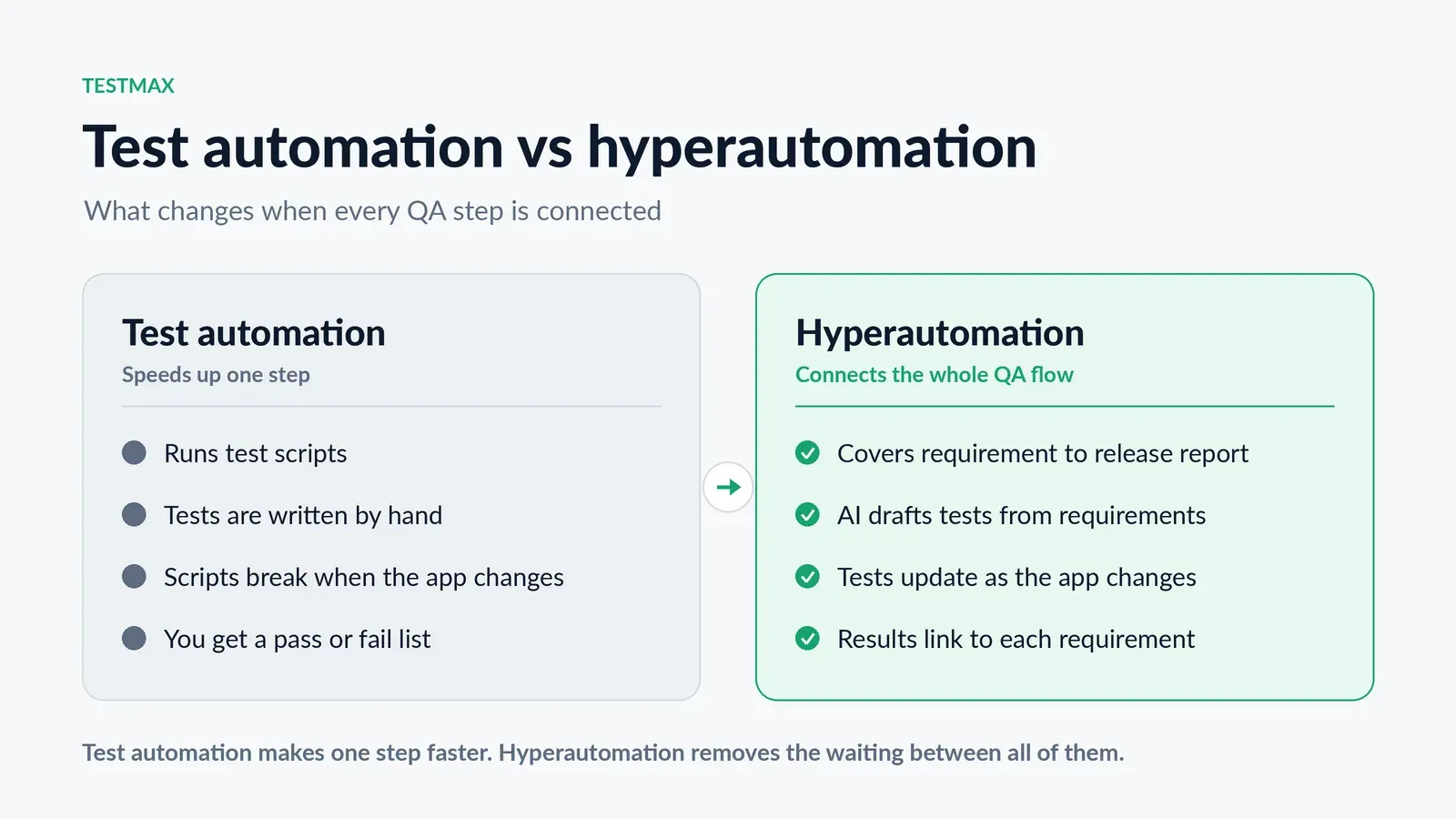
This is why many teams are now moving toward hyperautomation in software testing, where every step from requirement to report is connected.
How TestMax solves these challenges at the requirement level
TestMax, the AI test automation platform by Mammoth-AI, is built around one idea. Most testing problems start before the first test is written, so the fix should start there too.
- TestMax reads requirements from Jira, Azure DevOps or documents and checks them for gaps.
- It drafts test cases from those requirements, so writing tests no longer slows the team. See the AI test automation platform.
- Tests run on their own across web apps and APIs with AI test execution.
- Every result links back to its requirement, so coverage and ROI are easy to show.
Your QA team stays in charge of review and release approval. TestMax handles the repeat work in between.
Facing these automation testing challenges in your team? Book a TestMax demo and see it work on your own requirements.
FAQs
Q: What are the main challenges in automation testing?
A: The main challenges are test maintenance, flaky tests, unclear requirements, coverage gaps, slow test creation, test data, disconnected tools, skill gaps and proving ROI. Most of them start with unclear or missing requirements.
Q: Why does test automation fail?
A: Test automation usually fails when tests are built from scripts instead of requirements. Tests then break with every change, coverage stays unclear and teams spend more time fixing tests than finding bugs.
Q: How can QA teams reduce test maintenance?
A: Use stable locators, link every test to its requirement and remove flaky tests quickly. AI tools that update tests when the app changes can remove most of the repair work.