AI test automation
Let's Start Talking About Hyperautomation in Software Testing
Hyperautomation is more than more test scripts. It connects requirements, test creation, execution and reporting into one flow. Here is what it means for QA teams.
Quick answer
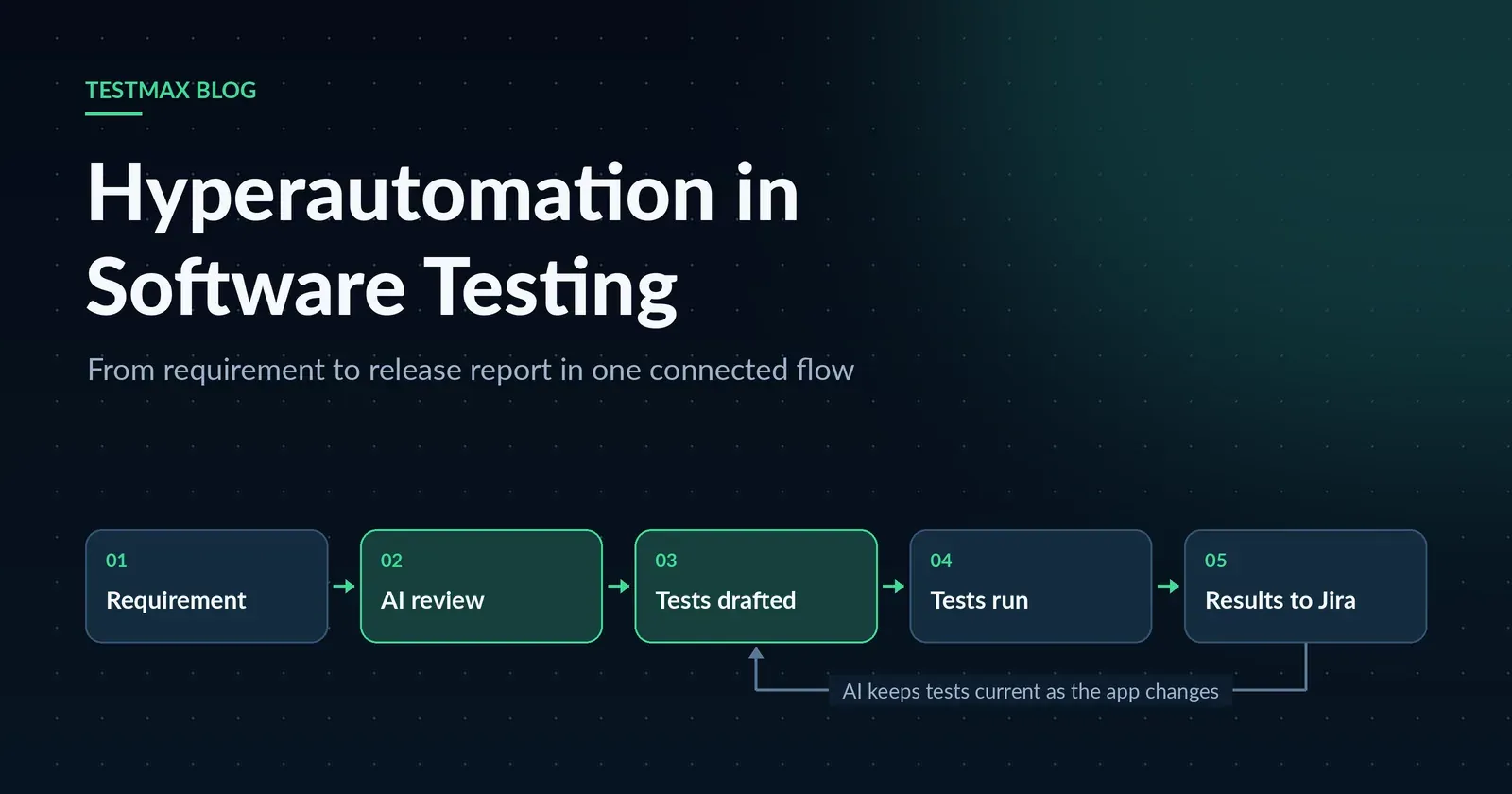
Hyperautomation in software testing means connecting every step of QA into one automated flow. Requirements turn into test cases, tests run on their own, results go back to Jira, and AI keeps the tests up to date as the app changes. Plain test automation speeds up one step. Hyperautomation removes the manual hand-offs between all the steps, so people spend their time on judgement, not on repeat work.
4 min read
Most QA teams already automate their testing. They have regression suites, CI pipelines and at least one test tool. Yet releases still wait on QA. The tests run on their own but almost everything around them is still done by hand.
Someone reads each new requirement. Someone writes the test cases. Someone repairs broken scripts, sorts the results and updates the ticket. Each of these steps looks small. Together they add days to every release. Hyperautomation is how teams close those gaps.
What is hyperautomation?
Gartner introduced the term and named hyperautomation a top strategic technology trend for 2020. The goal is to automate complete processes instead of single tasks. It does this by combining several technologies such as AI, machine learning, workflow tools and system integrations (Oracle).
In software testing the meaning is practical. Every step from a new requirement to the final release report runs as one connected flow. People step in only where their judgement adds real value.
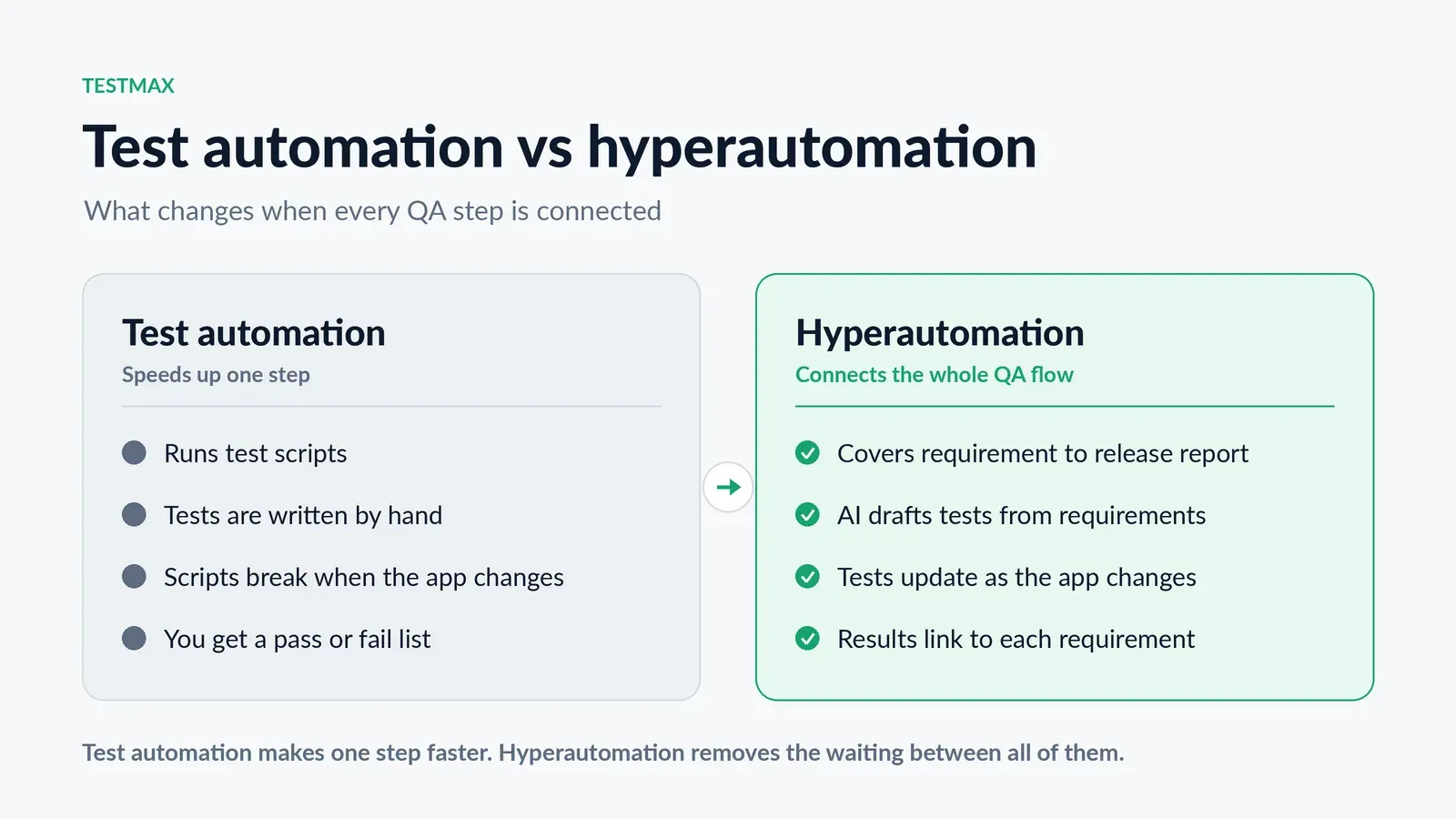
Test automation and hyperautomation are not the same
The two terms are often used as if they mean the same thing. They do not.
Test automation makes one step faster. Hyperautomation removes the waiting between all of them.
What a hyperautomated QA flow looks like
Here is how the work moves when every stage is connected.
- A requirement arrives. A user story or specification lands in Jira or a shared document.
- AI reviews the requirement. It looks for missing details and unclear rules before any test is written.
- Test cases are drafted. AI creates tests for the main path, the edge cases and the negative cases.
- A person reviews them. A QA lead approves, edits or rejects each draft. This is where human judgement matters most.
- Tests run automatically. They run on every build across browsers and APIs without anyone starting them.
- Results flow back. Each result is linked to its requirement and ticket. The whole team can see what is covered and what failed.
- Tests stay current. When the application changes, AI updates the affected tests instead of letting them break.
People remain part of this flow. They simply stop doing the repetitive work.
Why QA leaders are paying attention now
Three changes have made hyperautomation practical for testing teams.
Code is arriving faster than ever. AI coding assistants help developers ship more code each week. Writing every test by hand can no longer keep pace. We explored this challenge in our guide to testing AI generated code.
AI can now understand requirements. Modern language models can read a user story well enough to draft useful tests. A few years ago this was not realistic.
Test maintenance has become too expensive. Many teams now spend more time repairing tests than writing new ones. Broken scripts and flaky tests slow down every release.
AI agents take this a step further. An agent can plan a task, carry it out and check its own work across several steps. You can read more in our article on agentic AI in software testing.
How to get started in five steps
You do not need to change everything at once. A steady approach works better.
- Map your current QA process. Write down every step from a new requirement to release approval. Mark each step as manual or automated.
- Find the longest wait. Look for the step where work sits idle the longest. For most teams it is writing new tests or fixing old ones.
- Improve your requirements first. AI can only test what is clearly written. Good acceptance criteria lead to better tests.
- Connect your tools. Your test platform should read from and report to the tools your team already uses such as Jira and your CI pipeline.
- Start with one product area. Prove the approach on a single module. Measure the time saved and then expand.
Mistakes that slow teams down
Buying tools without connecting them. Five tools that do not share data are not hyperautomation. They are simply more tools to manage.
Taking people out of review. AI is good at drafting tests. People still need to decide what matters most to the business.
Ignoring requirement quality. Unclear requirements produce unclear tests. Automation only makes that problem appear faster.
Counting tests instead of coverage. A larger test suite is not the goal. Track requirement coverage and time to release instead.
Where TestMax fits
TestMax was designed around this connected flow. It begins with your requirements rather than with scripts. We call this approach requirement driven testing.
TestMax reads your requirements and drafts test cases from them. You can see how this works on our AI test automation platform page. Tests then run on their own through AI test execution across web applications and APIs. Results connect back to your tickets through our Jira test automation integration.
Your QA team stays in control of review and release approval. TestMax handles the repetitive work in between.
Want to see a hyperautomated QA flow built from your own requirements? Book a TestMax demo.
Related reading: our guide to AI-driven test automation platforms.