Autonomous QA and AI agents
What Is Superintelligence? A Plain Guide for Software Teams
Superintelligence is everywhere in the news. Here is what it actually means, how it differs from AGI and what it changes for software and QA teams today.
Quick answer
Superintelligence is a form of artificial intelligence that would far outperform humans in almost every field, from science and planning to decision making. It is different from todays narrow AI, which is strong at specific tasks, and from AGI, which would match human ability across many tasks. As of October 2026, superintelligence does not exist, but the idea is shaping how AI is built, governed and tested.
3 min read
Superintelligence has moved from research papers into headlines, company strategies and policy debates. For software teams the word can sound distant, even like science fiction. Yet the idea behind it is already changing how software is written, reviewed and tested.
This guide explains what superintelligence is, how it differs from today’s AI and what it means in practice for developers and QA teams.
What is Superintelligence?
Superintelligence is a form of artificial intelligence that would far outperform humans in almost every field. The philosopher Nick Bostrom, who made the term widely known in his 2014 book Superintelligence, describes it as an intellect that goes far beyond human ability in nearly every area that matters.
The key word is every. A system that beats humans at chess or protein folding is impressive, but it is not superintelligent. Superintelligence would be better than the best human experts at science, strategy, writing code, solving new problems and much more, all at once.
As of October 2026, no system meets this definition. Some AI tools perform at or above expert level on narrow tasks, but none outperforms people across the board.
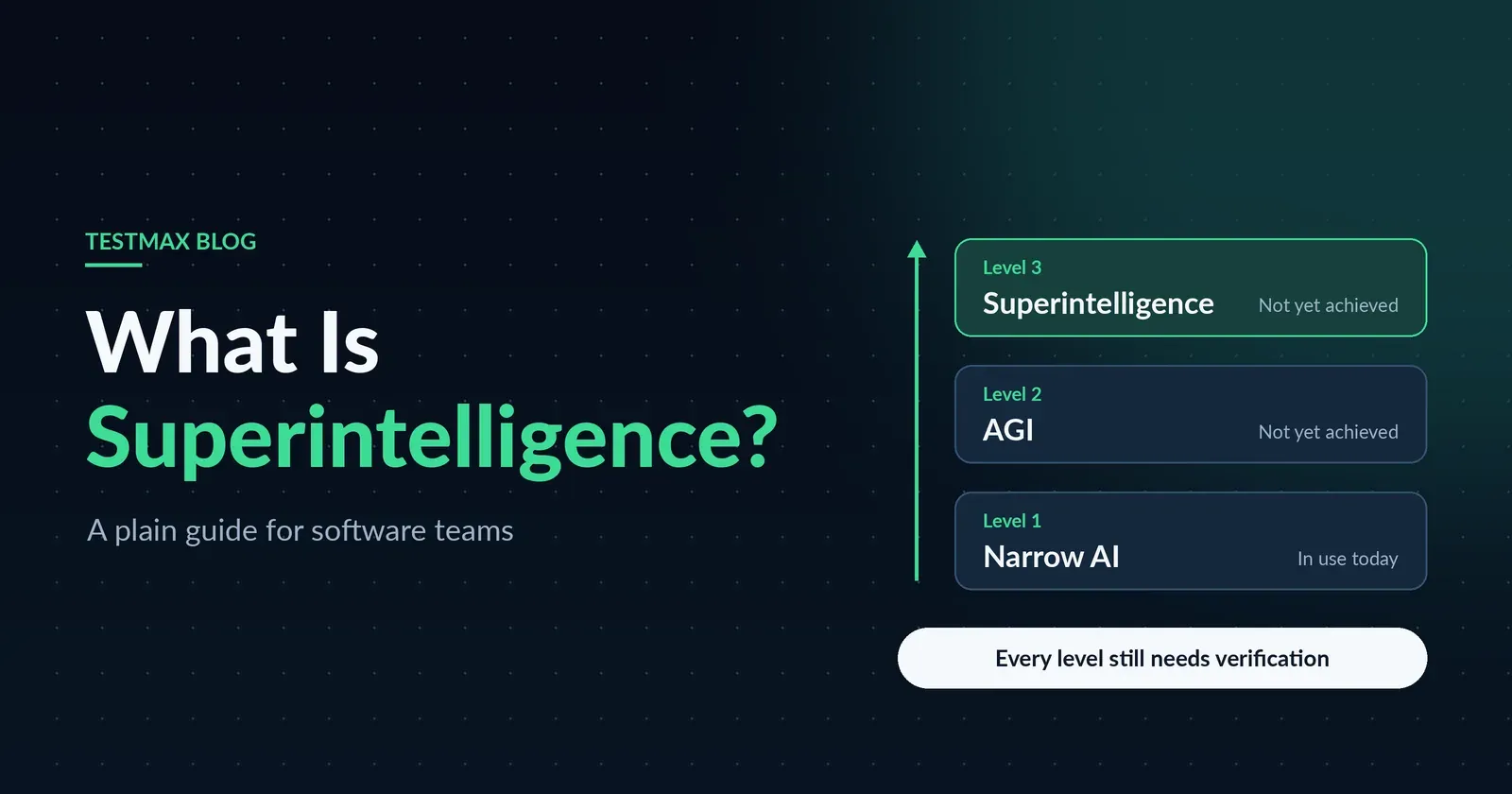
Narrow AI vs AGI vs Superintelligence
Most of the AI that software teams use today is narrow AI. It can write a function, suggest a test or summarise a log, but it still needs people to set goals and judge results.
Where are we today?
Several large AI labs and companies now name superintelligence openly as a goal, and governments are discussing how it should be guided and governed. At the same time, experts disagree on when or whether it will arrive, and some argue its risks call for strict limits.
For software teams, the practical point is simpler. Whatever the timeline, AI systems are already becoming more capable every year, and more of the code we ship is written with their help. One 2026 industry survey, the Sembi Software Quality Pulse Report, found that about 53% of code is now written by AI or with AI assistance.
What Superintelligence means for software teams
As AI writes more of our software, the hard part is no longer building code. It is proving that the code does what it should. This is the gap tools like TestMax are built to close.
Three changes are already visible:
- Code arrives faster than people can review it. AI coding tools and agents can produce more changes in a day than a team can read line by line.
- Mistakes look more convincing. Capable AI writes code that looks clean and confident, even when it is wrong.
- Expertise moves to the requirement. The most valuable human input becomes a clear description of what the software must do.
The verification gap
Testers have long talked about the “test oracle problem”: how do you know what the correct result should be? As AI grows more capable, this question gets harder. When an AI system knows more than the person checking its work, “looks right” is no longer enough.
The only reliable reference is a clear, written requirement: what the software must do, for whom and under which rules. Testing against that requirement is how teams stay in control, however capable the AI becomes. This is the idea behind requirement driven testing.
How TestMax fits
TestMax, the requirement driven AI testing platform by Mammoth-AI, is built for this shift. TestMax scores every requirement for quality and testability before tests are written. It then generates test cases and Playwright scripts, runs them on web apps and APIs and links every result back to the original requirement.
Whatever wrote the code, a person or an AI agent, TestMax shows what was tested, against which requirement and with what result. See how it works on the AI test automation platform page.
What QA teams can do today
You do not need to wait for superintelligence to prepare for it. These steps help with the AI tools you already use.
- Write testable requirements. Clear acceptance criteria are the foundation for checking any AI output.
- Link every test to a requirement. Traceability shows exactly what is covered and what is not.
- Treat AI written code as untrusted. Review and test it like code from a new team member. Our guide to testing AI generated code covers the common gaps.
- Keep people in the approval loop. Let AI draft and run tests, but keep release decisions with your team.
- Connect the whole flow. Move from single tools toward hyperautomation in software testing, where every step from requirement to evidence is linked.
For a deeper look at how AI agents are changing QA, read our guide to agentic AI in software testing.
Related reading: what an AI-driven test automation platform is.
AI is getting smarter. Is your testing keeping up? See how TestMax verifies AI built software.