AI test automation
TestMax vs mabl: Which AI Testing Platform Fits Your Team?
TestMax vs mabl, side by side: where tests come from, who owns them, where they run and how you buy. See which AI testing platform fits your QA team.
Quick answer
TestMax is the better fit when your testing starts from written requirements. It checks every requirement before a test is made, creates editable Playwright scripts your team owns, traces every result back to its requirement, and can run on premises. mabl suits teams that want a low-code recorder and auto-healing tests inside one managed cloud platform.
8 min read
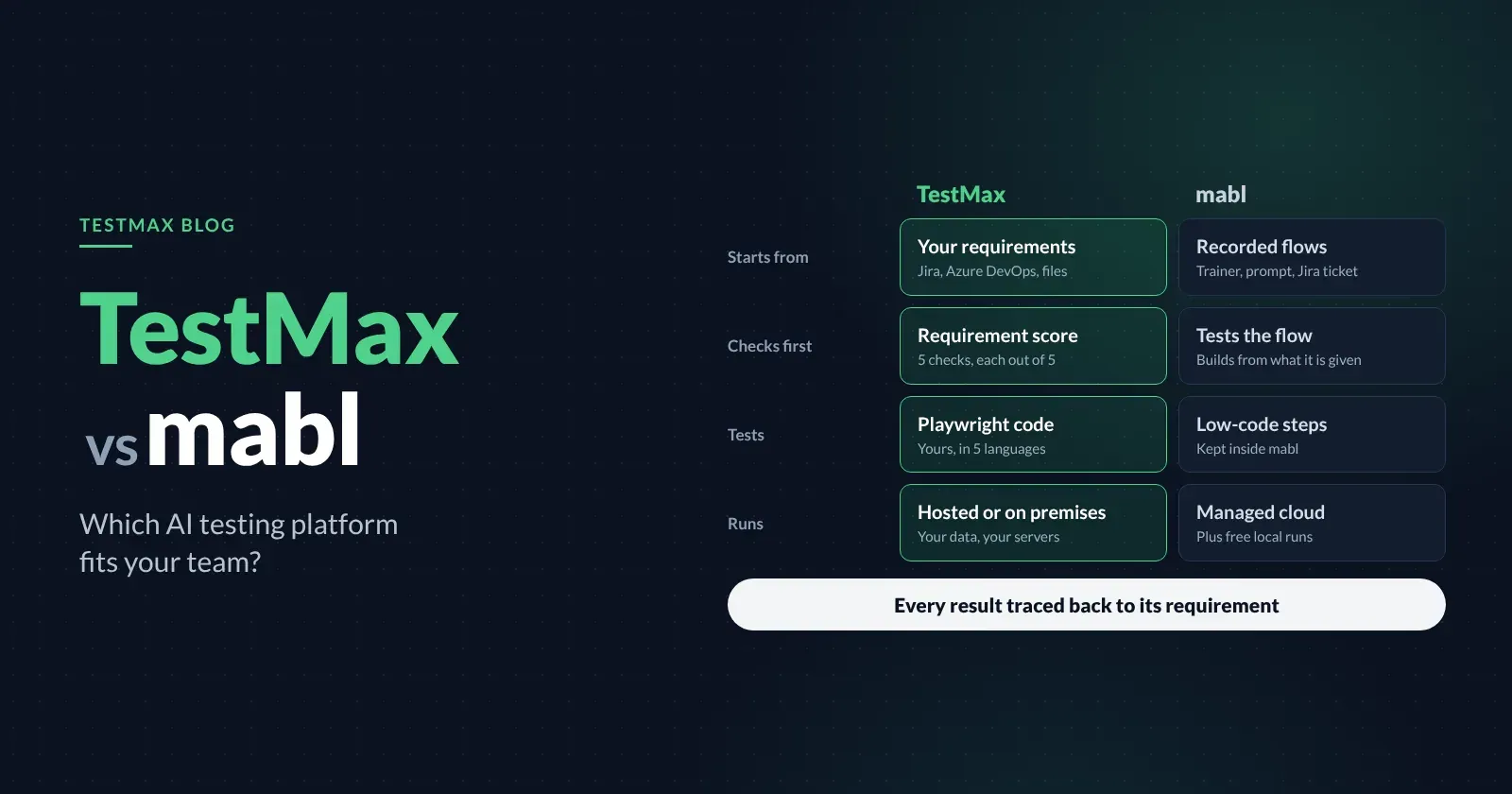
TestMax is the better fit when your testing starts from written requirements. It checks every requirement before a test is made, creates editable Playwright scripts your team owns, traces every result back to its requirement, and can run on premises. mabl suits teams that want a low-code recorder and auto-healing tests inside one managed cloud platform.
Both tools use AI to cut the time QA teams spend writing and fixing tests. They take different roads to get there. mabl builds and keeps tests inside its own platform. TestMax starts one step earlier, at the requirement, and hands you real test code at the end.
This guide compares the two on the points buyers ask about most: where tests come from, who owns them, where they run, how results trace back, and how you buy. Every fact about mabl comes from mabl's own website, linked at the end.
What is an AI testing platform?
An AI testing platform is software that uses AI to do the slow parts of testing for you: writing test cases, building automation, running it, and reading the results. An AI powered test automation platform goes further and keeps that automation working as the product changes.
Most tools in this group promise the same outcome: more coverage with less manual work. They differ in where they start and what they hand back to you. Some start from a recording of a person clicking through the app. Some start from a plain language prompt. Some start from the written requirement. That starting point decides how much you can trust what the tool builds, because a test can only prove what someone first wrote down.
TestMax and mabl sit at two different points on this map. That is why the same team can love one and find the other a poor fit.
What each tool is
What is TestMax?
TestMax is a requirement driven AI testing platform built by Mammoth-AI. It imports requirements from Jira or Azure DevOps, or from Word, PDF and CSV files. It scores each requirement for clarity, completeness, consistency, atomicity and testability, each out of 5. Then it reads the real application with App Scan, creates test cases and editable Playwright scripts, runs them, and links every result back to the requirement it came from.
What is mabl?
mabl calls itself an agentic testing platform. Teams create tests by clicking through the app in the mabl Trainer, or by describing a flow in plain language or pointing mabl at a Jira ticket. mabl runs the tests in its cloud, heals them when the UI changes, and finds the likely root cause of failures. It covers web, mobile (as an add-on), API, accessibility and performance testing.
How each tool works, step by step
TestMax: from requirement to result
- Import requirements from Jira, Azure DevOps, or Word, PDF and CSV files. TestMax keeps the link to each source item.
- Score each requirement on clarity, completeness, consistency, atomicity and testability. Fix the weak ones before you build tests on them.
- Scan the real application with App Scan, in Guided mode (you lead) or Autonomous mode (TestMax explores the screens).
- Review the test cases TestMax creates for each requirement.
- Get Playwright scripts in TypeScript, JavaScript, Python, Java or C#, and edit them like any other code.
- Run the tests with live logs.
- Share PDF and CSV reports, with every result traced back to its requirement. Push test cases back to Azure DevOps if you use it.
mabl: from flow to healed test
- Create a test by clicking through your app in the mabl Trainer, by describing the flow in plain language, or by pointing mabl at a Jira ticket.
- Run it in mabl's cloud, or locally for free, as part of your CI/CD pipeline.
- Let auto-healing handle routine UI changes. For bigger changes, mabl proposes a fix and waits for your approval.
- Read the failure analysis: mabl suggests whether a failure is a real bug, environment noise or a brittle step, and can pre-fill a Jira ticket.
- Track quality through quality scores, coverage trends and flakiness rates.
The difference is where each one starts. mabl starts from the flow on the screen. TestMax starts from what the business asked for, so every test can prove a requirement was met, not just that a page loaded.
TestMax vs mabl at a glance
Why QA teams choose TestMax
TestMax is built around one idea: every test should start from a requirement and end with proof. Here is what that gives your team.
Hours of work become minutes
In the TestMax benchmark model, work that takes hours by hand takes minutes with TestMax:
TestMax time is 3 minutes of supervising generation plus 5 minutes of review. Results vary by application and team. See the full breakdown.
Bad requirements are caught on day one
Most bugs that reach production begin as a vague requirement. TestMax gives every requirement a score on five checks, so your team fixes the gap before a single test is built on it. A gap fixed in the requirement costs far less than a bug fixed after release.
Your tests are real code
TestMax creates standard Playwright scripts in TypeScript, JavaScript, Python, Java or C#. They live in your repository, run in your pipeline, and stay yours if you ever change tools. No lock in.
Proof for every release
Every test case and every result links back to the requirement it proves. When a client, a manager or an auditor asks "was this tested?", you share one report instead of digging through spreadsheets.
Built for teams with strict rules
TestMax can be hosted for you or set up on premises, with role based user management and CSV export for audits. It is built by Mammoth-AI, which holds ISO 9001 and ISO 27001 certifications. That is why banks, insurers and healthcare teams can bring it inside their own walls.
See it on your own work. Bring three of your Jira or Azure DevOps stories to a short demo and watch TestMax score them, write the test cases and create the scripts. Book a TestMax demo.
The 4 differences that matter
1. TestMax checks the requirement first
A test is only as good as the requirement behind it. If a user story is vague, any tool will build a vague test, quickly. TestMax scores every requirement on five checks before it writes a single test. Your team sees what is missing, fixes it, and only then moves on. Read more in how to write testable requirements.
mabl can also start from a Jira ticket or a plain language description. Its site does not describe a step that grades the requirement itself.
2. Who owns the tests
TestMax gives you standard Playwright scripts in the language your team already uses. You can read them, change them, keep them in your own repository and run them anywhere Playwright runs.
mabl keeps tests as low-code steps inside its platform, with JavaScript snippets for complex cases. That is easier for testers who do not write code. The trade off is that your tests live in mabl.
3. Healing vs reviewing
mabl's strongest point is auto-healing. Its site says routine UI changes are fixed on their own, and bigger fixes are proposed and wait for your approval. If your UI changes every sprint and nobody wants to touch code, that matters a lot.
With TestMax, the scripts are yours, so your team reviews and updates them, with the requirement link showing what each test is meant to prove.
4. Where your data and tests sit
mabl runs as a managed cloud service. TestMax can be hosted for you or set up on premises. For banks, insurers, healthcare and other teams that cannot send test data to an outside cloud, that can decide the whole choice.
What changes for the QA engineer
The best way to compare two tools is to picture one normal sprint.
With TestMax, the QA engineer starts the sprint by importing the new stories. Weak requirements are flagged on day one, so the engineer goes back to the product owner with clear questions instead of guessing. Test cases and Playwright scripts come out of the reviewed requirements. At the end, the engineer shares a report that shows each requirement, its tests and the result. When a manager or auditor asks "was this tested?", the answer is one click away.
With mabl, the QA engineer records or describes the new flows and lets mabl build the tests. During the sprint, mabl heals tests when the UI shifts, and the engineer approves the bigger fixes. Failures arrive with a likely cause and a draft Jira ticket. The engineer spends less time fixing selectors and more time on exploratory testing.
Both save time. TestMax saves it at the start, where unclear requirements cause rework. mabl saves it in the middle, where broken tests eat the week.
Which one fits your team?
Some teams use both kinds of tool: one to make sure requirements are testable and traced, the other for broad regression runs. If you are not sure, start from the point that costs you most today. If it is unclear requirements and missing traceability, TestMax is built for that. For a closer look at what these tools really cost, read the hidden costs of AI test automation.
6 questions to ask any AI testing platform in 2026
Lists of the best AI test management platforms for 2026 change every few months. These questions do not. Ask them in every demo, including ours.
- Where do tests come from? A recording, a prompt, or your written requirements?
- Does the tool check the requirement first? Or does it build tests on whatever it is given?
- Who owns the tests? Can you export real code, or do the tests only run inside the tool?
- Can you trace a result back to its requirement? Ask to see the report an auditor would get.
- Where does it run? Cloud only, or on premises for regulated data?
- What does it cost as you grow? Ask how credits, runs, users and add-ons are counted.
See TestMax on your own requirements
A tool demo on sample data proves very little. Bring a few of your own Jira or Azure DevOps stories, and in one short session see TestMax:
- score each requirement on five checks and show what is missing
- create the test cases for each requirement
- turn them into Playwright scripts in your team's language
- link every result back to the requirement in one report
If your team works from requirements, needs proof for every release, or must keep test data on its own servers, TestMax was built for you. Book a TestMax demo.
Sources
All mabl facts are from mabl's own website, checked on 06-Nov-2026:
- mabl for QA: test creation from natural language or a Jira ticket, root cause analysis, auto-healing with approval for bigger changes
- mabl pricing: custom quotes, 500 cloud run credits a month to start, free local runs, mobile add-on, 14 day free trial
- mabl auto-healing: GenAI auto-healing
- mabl test reliability: element attributes captured for healing
TestMax benchmark numbers are from Why TestMax. Other TestMax facts are from What Is TestMax? and the TestMax support page.