

Requirement-Driven Autonomous Testing vs Traditional Test Automation
Most QA failures don't begin on the test floor. They begin in a requirements document nobody properly analyzed.
By the time a test engineer writes a test script, the damage is often already done with ambiguous acceptance criteria that have been misinterpreted, edge cases have been ignored, and entire functional areas have been left unspecified. Traditional automation then executes on top of that flawed foundation. The tests pass. The product fails.
Requirement-Driven Autonomous Testing flips this model entirely. Instead of writing tests after development, it extracts testable intelligence directly from requirements before a single line of code is written. This isn't a tooling upgrade. It's a structural shift in when and how QA begins.
The Problem with Traditional Test Automation
Traditional test automation was built to replace manual execution not to rethink the QA process. And that limitation shows.
Manual test case creation consumes 40–60% of a QA team capacity. Engineers interpret requirements, map them to scenarios, and write scripts by hand in a process thats slow, inconsistent, and entirely dependent on individual interpretation.
Script maintenance burden compounds the problem. Every UI change, API update, or business rule revision requires scripts to be rewritten. Studies suggest that up to 30% of automated test suites require rework after each major release cycle.
The automation backlog becomes a permanent fixture. Development ships faster than QA can automate. The gap widens with every sprint.
Coverage gaps are invisible by design. When test cases are written after development, they reflect what engineers assume matters not what the requirements actually specified. Entire scenarios go untested because no one mapped them back to source requirements.
Traceability challenges make audits painful. Connecting a failing test to the specific requirement it validates often requires manual cross-referencing across spreadsheets, Jira tickets, and test management tools none of which stay synchronized.
Traditional automation solves the execution problem. It never solves the intelligence problem.
What is Requirement-Driven Autonomous Testing?
Requirement-Driven Autonomous Testing is a testing methodology in which AI systems parse, analyze, and convert requirements into executable test cases autonomously, before development begins.
The requirement is input. The test case is the output. No manual interpretation is required.
This approach rests on three principles:
- Requirement-first philosophy: Testing logic is derived from specifications, not assumptions.
- AI-driven workflow: Natural language requirements are processed by AI to extract intent, edge cases, and acceptance criteria automatically.
- Continuous traceability: Every test case maintains a live link to the requirement that generated it creating an unbroken chain from specification to evidence.
Requirement-Driven Autonomous Testing is not an extension of traditional automation. It is a replacement for the manual cognitive work that precedes it.
Traditional Test Automation: Workflow
- Requirements received — QA team reads Jira tickets or user stories
- Manual interpretation — Engineers decide what to test based on experience
- Test case authoring — Test cases written manually in spreadsheets or test management tools
- Script development — Automation engineers write scripts in frameworks like Selenium or Cypress
- Test execution — Scripts run against a build, typically in staging
- Bug reporting — Failures flagged, developers investigate
- Script maintenance — post-release, scripts updated to reflect UI or logic changes
- Cycle repeats — For every new feature, the entire process restarts from step 2
Each step introduces latency, human error, and coverage risk.
Requirement-Driven Autonomous Testing: Workflow
- Requirements ingested — User stories, acceptance criteria, or structured specs from Jira, Azure DevOps, or documentation imported directly
- Requirement Intelligence analysis — AI analyzes requirements for clarity, completeness, consistency, and testability
- Requirement enhancement — Gaps, ambiguities, and missing edge cases flagged and resolved before development begins
- AI test case generation — Test cases generated automatically from requirement intent, covering positive, negative, and boundary conditions
- Autonomous script creation — Executable test scripts produced without human authoring
- Autonomous execution — Tests run against builds with no manual trigger required
- Evidence collection — Screenshots, logs, and execution artifacts captured automatically
- Requirements Traceability Matrix generated — Every test result linked back to its originating requirement in real time
- The process is closed loop. Every output traces back to a requirement. Every gap in requirements is caught before it becomes a bug in production.
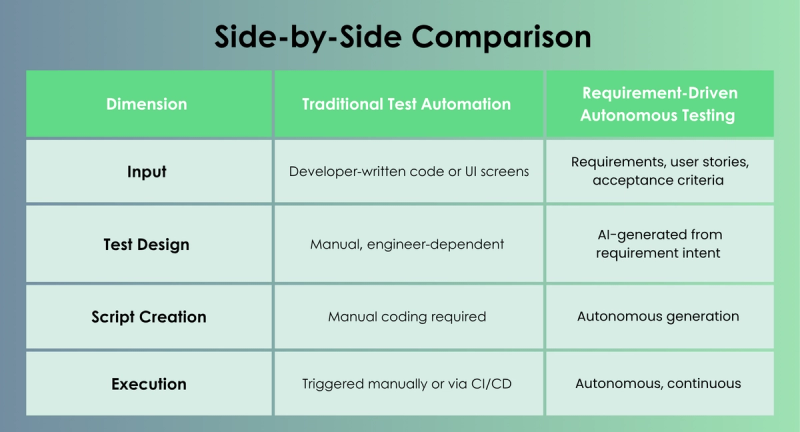
Traditional Test Automation vs Requirement-Driven Autonomous Testing
Input
Traditional Test Automation
- Relies on developer-written code
- Depends on completed UI screens
- Testing starts after development
Requirement-Driven Autonomous Testing
- Uses requirements, user stories, and acceptance criteria
- Begins testing preparation before coding starts
- Shifts quality assurance earlier in the SDLC
Test Design
Traditional Test Automation
- Manual test case creation
- Highly dependent on QA engineers
- Quality varies by tester experience
Requirement-Driven Autonomous Testing
- AI generates test cases from requirement intent
- Consistent test coverage
- Reduced human dependency
Script Creation
Traditional Test Automation
- Requires manual Selenium or Playwright coding
- Time-consuming development effort
- Frequent scripting bottlenecks
Requirement-Driven Autonomous Testing
- Scripts generated automatically
- No manual coding required
- Faster automation delivery
Execution
Traditional Test Automation
- Triggered manually or through CI/CD pipelines
- Requires ongoing human oversight
Requirement-Driven Autonomous Testing
- Autonomous and continuous execution
- Minimal human intervention
- Faster feedback cycles
Maintenance
Traditional Test Automation
- Significant rework after UI or feature changes
- High maintenance overhead
Requirement-Driven Autonomous Testing
- AI adapts to requirement and application changes
- Reduced maintenance effort
- Lower technical debt
Traceability
Traditional Test Automation
- Manual mapping between requirements and tests
- Difficult to maintain at scale
Requirement-Driven Autonomous Testing
- Automatically generates a Requirements Traceability Matrix (RTM)
- End-to-end requirement coverage visibility
Scalability
Traditional Test Automation
- Growth limited by QA team size
- Additional projects require more engineers
Requirement-Driven Autonomous Testing
- Scales with requirement volume
- Supports rapid product growth without proportional staffing increases
Cost
Traditional Test Automation
- High costs for script development and maintenance
- Significant engineering effort required
Requirement-Driven Autonomous Testing
- Lower operational costs
- Reduced manual effort and maintenance burden
Speed to Coverage
Traditional Test Automation
- Coverage often takes weeks per feature cycle
- Delays testing readiness
Requirement-Driven Autonomous Testing
- Coverage generated within hours of requirement submission
- Accelerates release velocity and time-to-market
The Role of Requirement Intelligence
Requirement Intelligence is the analytical engine behind Requirement-Driven Autonomous Testing. It operates before test generation begins because a poorly specified requirement produces a poorly designed test, regardless of how sophisticated the AI is.
Requirement Intelligence performs five functions:
Clarity analysis — Identifies vague or ambiguous language. Terms like "the system should respond quickly" are flagged and returned for human resolution before testing begins.
Completeness analysis — Detects missing scenarios. If a login requirement specifies successful authentication but doesn't address failed attempts or account lockouts, Requirement Intelligence surfaces those gaps.
Consistency analysis — Cross-references requirements to identify contradictions. A checkout flow that specifies two different tax calculation methods in different tickets will be caught before it creates conflicting test cases.
Testability scoring — Assigns each requirement with a testability score based on specificity, measurability, and verifiability. Low-scoring requirements are queued for revision.
Requirement enhancement — Suggests additions, clarifications, and edge cases that make requirements more complete and by extension, more testable.
Requirement Intelligence transforms requirements from a communication artifact into a testing asset. It is the foundational capability that makes Requirement-Driven Autonomous Testing possible at scale.
How AI Generates Test Cases from Requirements
The AI test case generation layer in a Requirement-Driven Autonomous Testing platform reads requirements the way a senior QA architect would but faster, more consistently, and across every requirement simultaneously.
The system processes:
- User stories in the format As a [role], I want [feature], so that [outcome] — extracting the actor, the action, and the expected result as testable conditions
- Acceptance criteria mapped directly to pass/fail conditions in generated test cases
- Jira requirements ingested through native integration, with field mappings preserved for traceability
- Azure DevOps requirements processed through work item APIs, maintaining hierarchy between epics, features, and stories
For a single requirement like Users with expired passwords must be prompted to reset before accessing the dashboard, Requirement Intelligence generates:
- Positive case: expired password triggers reset prompt
- Negative case: non-expired password proceeds without prompt
- Boundary case: password expiring on the exact day of login
- Security case: reset link expires after one use
- Edge case: user closes reset modal without completing reset
A traditional automation team might catch two of these. Requirement Intelligence catches all five before development writes a single function.
Why Traditional Automation Creates Technical Debt
Every manually written test script is a liability.
When the application changes, scripts break. When business logic evolves, scripts become incorrect not just broken. They continue to pass while testing something that no longer exists.
Self-healing test scripts have been marketed as the solution, but they address UI selector drift, not semantic drift. A self-healing script adjusts when a button moves. It cannot adjust when the business rules the button implements changes.
Requirement-Driven Autonomous Testing eliminates this debt at the root. Because tests are generated from requirements, when a requirement changes, the test suite regenerates not repairs. The test always reflects current business intent, not historical UI state.
The maintenance burden disappears because the source of truth shifts from code to requirements.
How Autonomous QA Eliminates Manual Work
An Autonomous QA Platform built on Requirement-Driven Autonomous Testing removes manual effort from every layer of the QA process:
AI test generation — No test case authoring. Requirements go in test cases come out.
Autonomous script execution — No manual run schedules. Tests execute trigger or continuously.
Evidence collection — Screenshots, logs, and execution traces collected automatically and attached to test results.
Requirements Traceability Matrix generation — RTM built in real time, linking every test to its source requirement without spreadsheet work.
Reporting — Stakeholder-ready dashboards generated from execution data, not manually compiled.
The QA team shifts from execution to strategy reviewing AI outputs, refining requirements, and analyzing coverage rather than writing scripts.
This is what Autonomous QA looks like in practice: not automation that reduces effort, but autonomy that eliminates categories of work entirely.
The Future of Software Testing
Software is becoming too complex, and release cycles too compressed, for manually authored test suites to remain viable.
The next evolution of QA is not more automation engineers writing more scripts. It is AI agents operating directly on requirements understanding business intent, generating coverage, executing tests, and reporting results without human mediation at every step.
Requirement-Driven Autonomous Testing is the architectural foundation of this shift. It connects the two ends of the delivery of pipeline requirements and test evidence with an intelligent layer that removes the manual gap between them.
Teams that adopt this model gain something beyond speed: they gain structural confidence that what was specified is what was tested, and that what was tested is documented with evidence.
That is the standard the industry is moving toward. The question is not whether Requirement-Driven Autonomous Testing becomes the default model. It is which teams get there first.
Conclusion
Traditional test automation solved the right problem at the wrong stage. It made execution faster while leaving the intelligence gap the space between requirements and test design entirely manual.
Requirement-Driven Autonomous Testing closes that gap. It moves QA upstream, into the requirements phase, where the cost of finding problems is lowest and the impact of catching them is highest.
The key differentiators are clear: AI-generated test cases from source requirements, autonomous execution, automated Requirements Traceability Matrices, and a Requirement Intelligence layer that improves specifications before development begins.
TestMax AI is built on this model an Autonomous QA Platform that operationalizes Requirement-Driven Autonomous Testing at enterprise scale. Not AI-decorated testing. Requirement-driven, AI-operational testing from specification to evidence, with every step connected.
Frequently Asked Questions
Q: What is Requirement-Driven Autonomous Testing?
Requirement-Driven Autonomous Testing is a QA methodology in which AI systems parse requirements directly and generate test cases, scripts, and traceability artifacts automatically — before or alongside development, rather than after it.
Q: How is Requirement-Driven Autonomous Testing different from traditional test automation?
Traditional automation automates script execution. Requirement-Driven Autonomous Testing automates the entire QA workflow from requirement analysis through test generation, execution, evidence collection, and traceability without manual authoring at any stage.
Q: What is Requirement Intelligence?
Requirement Intelligence is an AI-powered analysis layer that evaluates requirements for clarity, completeness, consistency, and testability before test generation begins. It surfaces gaps and ambiguities that would otherwise produce incomplete test coverage.
Q: Can Requirement-Driven Autonomous Testing integrate with Jira and Azure DevOps?
Yes. Requirements ingested from Jira, Azure DevOps, and other requirement management tools can be processed directly, with field-level traceability maintained throughout the test lifecycle.
Q: What is a Requirements Traceability Matrix, and how does autonomous QA generate it?
A Requirements Traceability Matrix (RTM) maps every test case back to the requirement it validates. In a Requirement-Driven Autonomous Testing platform, the RTM is generated automatically as test cases are created and executed eliminating the need for manual cross-referencing.
Q: Does Requirement-Driven Autonomous Testing eliminate the need for QA engineers?
No. It eliminates the manual, low-value work script authoring, maintenance, spreadsheet traceability and redirects QA engineers toward higher-value activities: requirement refinement, coverage strategy, and output review.